
Creating Hope from Garbage
Episode Two Continued

LIVE TRANSMISSION
July 12, 2042
But where are all these happy workers?
Guess I’ve learned all I can about the history of the Apex Miners Collective from my tour of this most unusual museum. Time to head back outside and explore the sitch on the ground.
First, a quick stop in the empty lobby for one more gulp of lukewarm water. Steel myself for the blast of heat waiting outside the door. Why did I sign up for this again? Oh yeah, because traveling across the continent searching for communities that offer hope for better futures beats being homeless in the present. Jury still out on that one.
THE APEX COMPLEX
Giant tubes connect the other buildings in the complex to the mountain of trash. Like they’re on landfill life support. Whatever mystery materials are being digested by the building cause the tubes to shudder and groan.
Whatever is going on inside is hidden behind windowless walls that look like they were squeezed out of a tube. Grey toothpaste. 3-D printed. Not unusual, but where did they get the raw material? Thought this technique required pretty specialized concrete.
Tap on the nearest wall. Def not regular concrete but solid. Try the door. Locked. Guessing no workers inside.
At the far end of the cluster, set slightly apart from the other buildings, is a much larger structure. Looks original. Traditional block building, massive steel door covers most of the end. Smaller regular door, faded red, off to the side. Worth a try.
THE CITIZENS OF APE
Door opens into a cavernous space. Must have been the transfer station where diesel-belching dump trucks dropped tons of garbage 24-7. All evidence of those days gone. Replaced by clusters of tables, seating areas, walls covered in more solarpunk worker murals. And people.
A few hundred people. Some gathered in small clusters, catching up no doubt on the latest gossip. Lots of kids, being kids—running, shouting, scuffling. Parents make half-hearted efforts to control them. The community is a global mix- brown, black and white in fairly even numbers. Likely a close approximation of the demographics of Vegas before it collapsed. Def a lively, vibrant community. Good sign.
A cafeteria dominates one end of the room. Line waits patiently as workers set up steam trays of wood. Even from here, I can pick up on the inviting aromas. When did I eat last?
My arrival does not go unnoticed. A few people nod in greeting; most simply clock my presence and go on with their conversations. One middle-aged man in dungarees and work shirt heads toward me.
MATEO: Hola. Welcome to Apex. If you’re looking for the business office, it opens at 7:00 pm.
JOHNNY: Oh, no, I uh, actually, I’m from The Practopia Project. They sent me here to, uh, learn about your community. Guess they’ve heard that you’re doing some things that might be useful for others to know about, uh, in terms of how, you know, you are building an alternative community.
MATEO: Mateo Rodriguez. Good timing. We’re just starting our day. Come join me for breakfast. Happy to answer your questions.
JOHNNY: Great, I saw your, uh, museum. Very, uh, inspiring mural at the end.
MATEO: Thanks. Actually, that’s my work. Most of the ones in here too.
JOHNNY: You’re an artist. How’d you end up here?
MATEO: Set painter back in the day. I’m like almost everybody here, lost my job when Vegas went sideways. Heard about this place, figured I’d check it out. Been here almost three years now.
JOHNNY: How does the community support itself?
MATEO: This pile of garbage is a goldmine. Started out recycling the easy stuff, like plastics, building material, soft goods. We’ve gotten way more sophisticated. Extract everything from precious metals to lactic starters for making bioplastics. Able to produce just about everything we need plus way more. Export stuff all across the southwest, far as the Republic of Texas.
JOHNNY: Where’d you get the expertise?
MATEO: That was all Gus Mallick. He was head engineer before. Stayed when the plant closed down. Said he was too damn old to start over. Taught folks how to maintain the equipment and even oversaw a lot of the newer automation. Now, machines do most of the nasty work. We just make sure they stay happy. Sadly, we lost Gus last year.
JOHNNY: Sounds the operation is energy intensive. How do you manage that with all the shortages?
MATEO: Sitting on top of it. The methane produces plenty of electricity. And we’re making our own solar panels from reclaimed silicon. Soon we’ll be a carbon-free energy exporter.
JOHNNY: Impressive.
MATEO: We’re already about 70% self- sufficient. Biggest challenge is growing our own food. Chemicals from the landfill poisoned the soil. Take decades to clean it up. But we’re making some progress with hydroponics and permaculture.
JOHNNY: That’s what’s going on in the building?
MATEO: That and some of the more toxic recycling processes. Our goal is to leave this place clean when we finally use up all the garbage.
JOHNNY: How long with that take?
MATEO: Not sure. Generation or more.
JOHNNY: And then what?
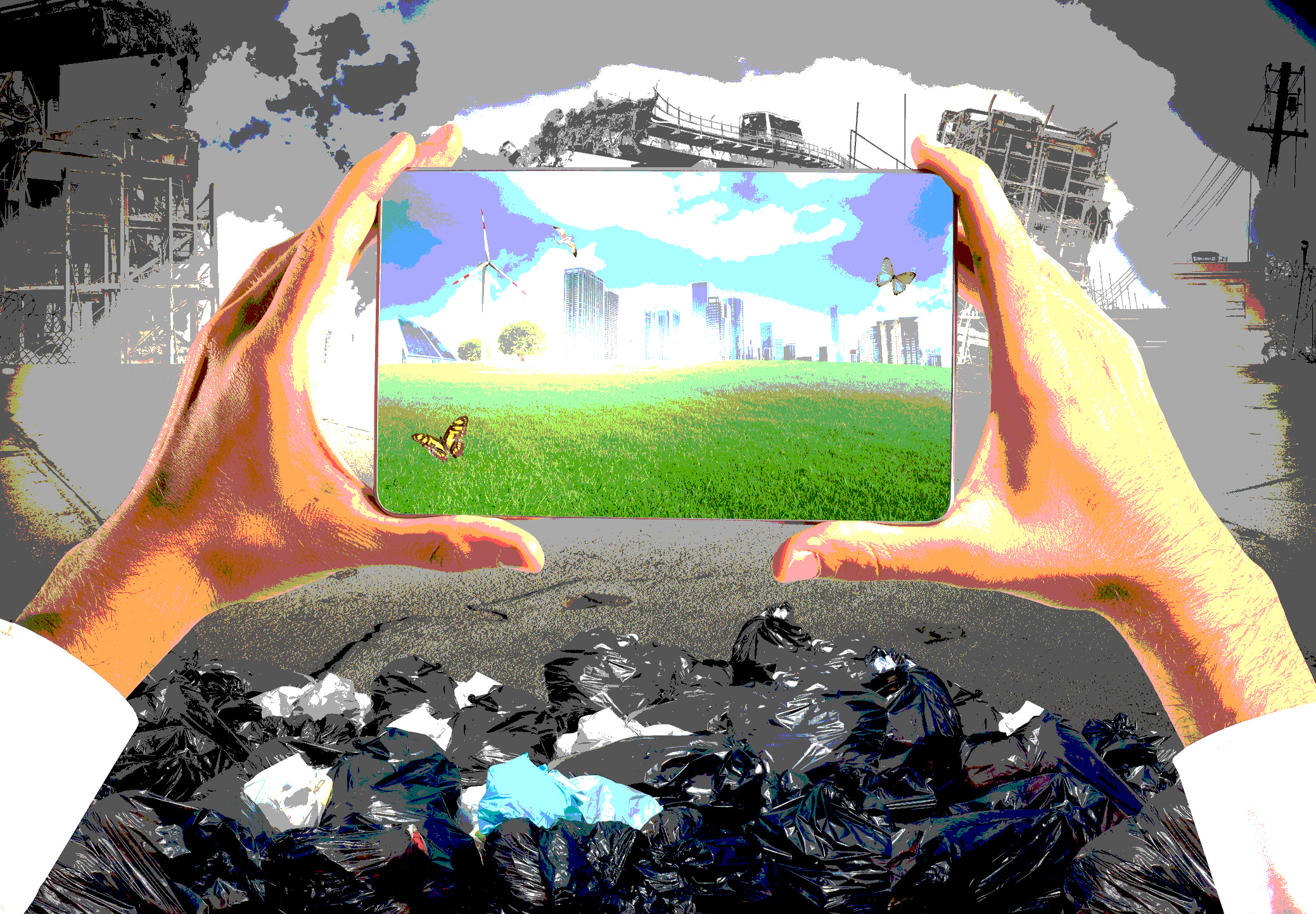
MATEO: Some people are hoping we can turn it into a little patch of green here in the desert. If not, plenty of other landfills to be mined.
JOHNNY: Sounds like hard work.
MATEO: No worse than being a wage chaser in the old economy. Here, we’re all owners. Everybody pitches in. Nobody has to work two, three jobs just to feed their family.
JOHNNY: Still can’t imagine landfill miner shooting to the top of preferred careers, even in these times.
MATEO: We get at least twenty applicants every week. We’ve got it better than a lot of folks. Grab a tray. Let’s get some chow.
JOHNNY: OK
MATEO: Try the protein patty but get the extra sauce. They can be a little dry.
[SOUND OF PEOPLE GETTING FOOD, SILVERWARE CLANGING, CONVERSATION AND LAUGHTER]
FINAL REFLECTIONS
JOHNNY: Mateo was right. The protein patty, a fancy name for ground insects, was dry, but edible. The Yaopon tea was the closest thing to coffee I’ve had in a long time. Three cups of that and I was feeling human again.
After breakfast, I watched as people flowed in and out of the community center. Everyone seemed to have a purpose, but no one seemed rushed. Took the time to eat, visit, play with the kids, before heading out into the cooler nighttime temperatures to work on whatever job they had. Way more chill than any day hustling in Vegas.
To be fair, Apex is not the perfect post-worker utopia depicted in Mateo’s murals. They have plenty of issues, not the least of which is, they live on top of a toxic landfill. That can’t be healthy, right? But most of the people I met seemed positive about the possibilities.
And if they succeed? What comes next? Do they give birth to a tribe of gypsy garbage reclaimers- traveling from one abandoned landfill to the next?
Could this be a model for other communities? Plenty of garbage left over from a century of unrestrained consumption. Not sure how many people would choose to spend their days digging through trash from the past to create tomorrow. Maybe we’re all already doing that in some way.
Oh well, not my problem to solve. I’m just here to observe and record.
Guess that’s all for now.
[TRANSMISSION DISCONNECTS]
[RECONNECTS]
Oh crap, forgot the tag out. Uh, Til next time, this is, uh, Johnny Darlin with the Practopia Project, Searching for Hope AfterAmerica.